
A Philosophical Inquiry into Problem-Solving and Human Action
Prabhash Chandra

Every human life is, in some measure, an encounter with the unresolved.
There are questions without immediate answers, circumstances that resist our intentions, relationships that refuse to conform to our expectations, institutions that behave differently from the way we designed them, and decisions whose consequences cannot be completely anticipated.
We call these situations problems.
But perhaps a problem is not merely something that stands in our way.
Perhaps it is an invitation to understand.
The history of human civilisation can, in many ways, be read as a history of this encounter: the encounter between uncertainty and intelligence, disorder and order, ignorance and knowledge, action and consequence.
Science attempts to understand the structure behind phenomena.
Philosophy questions the assumptions behind our understanding.
Engineering builds mechanisms to transform intention into reality.
Management develops systems for organised action.
And human beings, across all these disciplines, continue to ask one fundamental question:
How do we move from the labyrinth of confusion to the architecture of clarity?
This question lies at the heart of problem-solving.

The Problem Before the Solution
Our first instinct when confronted with a problem is often to search for an answer.
That instinct is understandable.
It is also frequently premature.
Before asking “How do I solve this?”, we should ask:
“What exactly am I trying to solve?”
A problem can broadly be understood as a significant gap between a current state and a desired state.
But this definition, though useful, is incomplete.
The visible problem may merely be a symptom.
A student may be underperforming.
An organisation may be losing efficiency.
A project may be delayed.
A relationship may be deteriorating.
A business may be losing customers.
But these are observations, not necessarily explanations.
The deeper question is:
What structure, process, behaviour or condition is producing the observed outcome?
The distinction is crucial.
If a room is repeatedly filling with water, removing the water is not necessarily the solution.
The broken pipe may be the problem.
Likewise, if an institution repeatedly encounters the same difficulty, correcting the visible incident without examining the underlying process may simply postpone recurrence.
A mature problem solver therefore does not merely ask:
“What happened?”
He asks:
“Why did it happen?”
And then:
“Why did that condition exist?”
And then:
“What system continues to reproduce it?”

The Discipline of Asking “Why?”
One of the simplest tools of problem-solving is also one of the most powerful:
Why?
A student is performing poorly.
Why?
Because the student is not practising adequately.
Why?
Because the student finds the questions difficult.
Why?
Because foundational concepts are weak.
Why?
Because earlier learning was not consolidated.
The problem has now changed.
It is no longer simply:
“The student is not working hard.”
It has become:
“There is a foundational learning gap.”
The difference between the two diagnoses is enormous.
One invites blame.
The other invites intervention.
This is why Root Cause Analysis is more intellectually useful than premature judgement.
A solution applied to the wrong problem is not merely ineffective.
It can make the original problem more difficult to understand.
The Labyrinth of Chaos
This is where the idea of Chaos Theory becomes philosophically interesting.
Chaos, in ordinary language, means disorder.
In mathematics and science, however, chaos has a much more precise meaning.
A chaotic system may be deterministic—it may follow definite underlying rules—yet remain extraordinarily sensitive to initial conditions.
A tiny difference at the beginning may produce a dramatically different outcome over time.
The famous Butterfly Effect is associated with this sensitivity.
The deeper lesson is not that everything is random.
It is almost the opposite.
There may be structure within apparent disorder.
There may be rules that we do not yet understand.
There may be relationships that are invisible at the surface.
There may be feedback mechanisms that amplify small disturbances.
And therefore:
What appears to be chaos may sometimes be complexity whose architecture we have not yet understood.
This is an extraordinarily useful attitude toward problems.
Do not immediately conclude that a system is irrational merely because its behaviour is difficult to predict.
First ask:
What pattern am I failing to see?
Small Causes, Large Consequences
Human beings tend to notice dramatic events.
We notice the collapse of a project, but not the series of small delays that preceded it.
We notice the failure of a relationship, but not the accumulation of unspoken grievances.
We notice poor academic results, but not the gradual erosion of foundational learning.
We notice organisational dysfunction, but not the small procedural deviations that became normalised.
Complex systems often magnify small deviations.
A minor communication gap can become a major conflict.
A small financial leakage can become a structural deficit.
A minor quality issue can become a loss of trust.
A small habit can become a defining pattern of behaviour.
Thus, one of the most important lessons of complexity is:
Never underestimate the significance of small beginnings.
The beginning of a problem is often quieter than its consequences.
Beyond Linear Thinking
Human reasoning naturally prefers linear explanations.
A caused B.
But complex systems frequently behave differently.
A may influence B.
B may influence C.
C may alter D.
And D may return to influence A.
This creates a feedback loop.
Consider:
Low confidence → low effort → poor performance → lower confidence.
Or:
Poor communication → misunderstanding → conflict → poorer communication.
Or:
Declining sales → reduced investment → declining quality → fewer customers → declining sales.
These are not merely chains of events.
They are self-reinforcing systems.
Therefore, solving a complex problem requires more than finding a cause.
We must identify the relationships that keep reproducing the problem.
This is the essence of Systems Thinking.
The System Behind the Problem
A school is not merely a collection of classrooms.
A business is not merely a collection of employees.
A family is not merely a collection of individuals.
An organisation is a living network of relationships, processes, incentives, expectations, information flows and feedback mechanisms.
Change one component and another may respond.
Improve one metric and another may deteriorate.
Solve one problem and unintentionally create another.
Therefore, before implementing a solution, we should ask:
“What else will this solution change?”
This is the question of systemic consequence.
A good solution does not merely improve the immediate situation.
It understands the environment in which the solution must live.
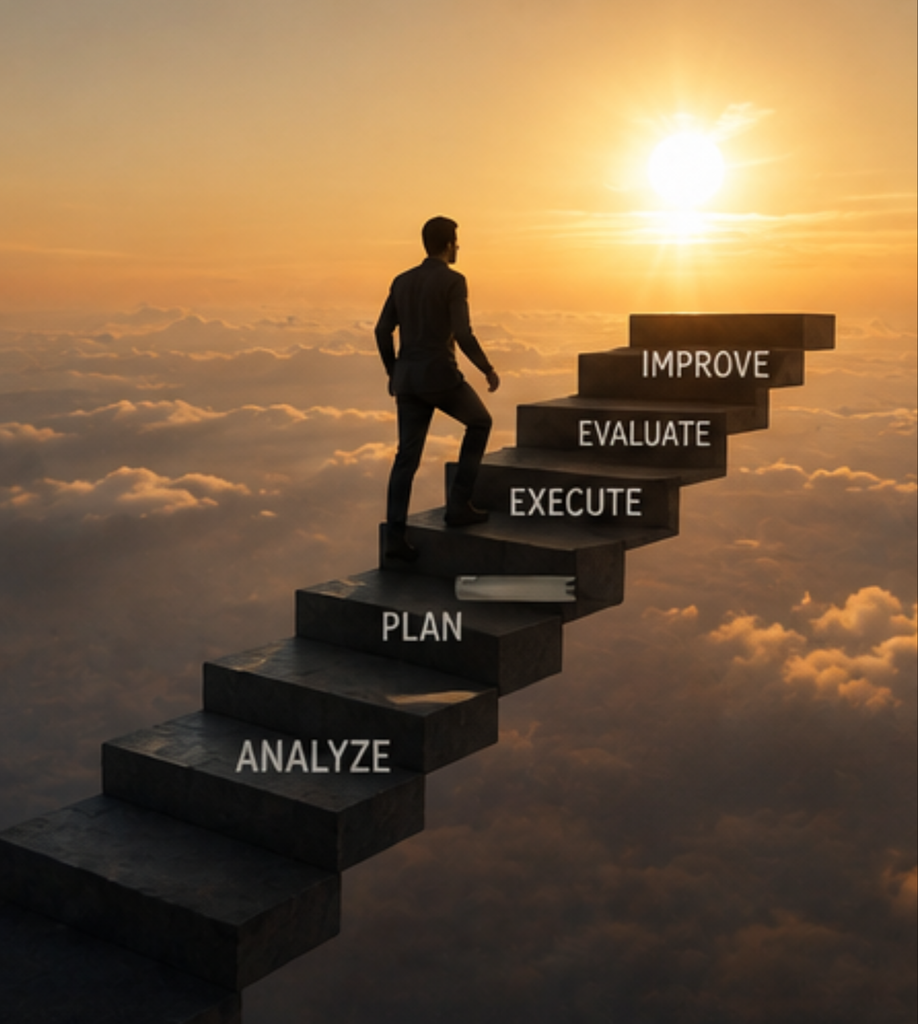
The Architecture of Problem-Solving
If chaos represents complexity, then problem-solving is an attempt to construct architecture within that complexity.
Architecture does not mean eliminating uncertainty.
It means creating a structure through which uncertainty can be understood and managed.
A disciplined problem-solving methodology can be expressed as:
Observe → Define → Diagnose → Analyse → Design → Act → Measure → Learn → Improve
This is not a rigid linear sequence.
It is an iterative process.
The outcome of evaluation may force us to redefine the problem.
New evidence may invalidate our diagnosis.
Implementation may reveal an unexpected constraint.
The solution may require redesign.
Thus, genuine problem-solving is not a straight road.
It is a cycle of inquiry and correction.
SDLC: From Intention to Implementation
Modern software engineering provides one of the clearest examples of disciplined problem-solving through the Software Development Life Cycle (SDLC).
While different SDLC models vary, the broad architecture generally involves:
Requirements → Analysis → Design → Development → Testing → Deployment → Maintenance
The deeper lesson extends beyond software.
Requirements
What is actually required?
Analysis
What is the present condition?
What are the constraints?
Design
What should the solution look like?
Development
How will it be created?
Testing
Does it work?
Deployment
Can it function in the real world?
Maintenance
How will it remain effective?
This final stage is frequently neglected.
People celebrate implementation and forget maintenance.
But a solution that cannot sustain itself is often merely a temporary intervention.
The lesson is profound:
A solution is not complete when it works once. It is complete when it can continue to work under changing conditions.
PDCA: The Rhythm of Improvement
The PDCA Cycle—Plan, Do, Check, Act—provides another powerful architecture for dealing with uncertainty.
PLAN
Define the problem.
Establish the objective.
Identify the proposed intervention.
DO
Implement the intervention.
CHECK
Measure the outcome.
Compare expectation with reality.
ACT
Standardise, modify or redesign.
Then begin again.
The genius of PDCA lies in its humility.
It does not assume that the first plan will be perfect.
It assumes that action produces information.
This is a profound principle.
We do not always learn before acting.
Sometimes we learn because we act.
Experience becomes data.
Data becomes feedback.
Feedback becomes knowledge.
Knowledge changes the next action.
And the cycle continues.
From Software Engineering to Human Action
SDLC and PDCA are modern frameworks.
They should not be retroactively projected into ancient Indian texts as though those texts were secretly describing modern software engineering or quality management.
That would be historically careless.
But modern frameworks and Indian philosophical ideas can be placed in conceptual dialogue.
Both ask important questions about:
- intention,
- action,
- consequence,
- correction,
- learning,
- discipline,
- and continuous refinement.
This dialogue becomes particularly meaningful when we turn to the Indian knowledge tradition.
The Indian Tradition of Inquiry
The Indian philosophical tradition does not begin with the assumption that every question has an immediate answer.
It begins with inquiry.
What is real?
What is knowledge?
Who is the knower?
What is action?
What is the consequence of action?
What is duty?
What is the nature of the self?
These questions reveal something fundamental about problem-solving:
Before solving the external problem, we may sometimes need to examine the mind that is attempting to solve it.
A biased observer can misinterpret data.
An anxious decision-maker can exaggerate risk.
An ego-driven leader can reject evidence.
A fearful individual can mistake uncertainty for danger.
Thus, the problem is not always entirely outside us.
Sometimes our way of seeing becomes part of the problem.
“Saṃgacchadhvaṃ Saṃvadadhvaṃ”: The Wisdom of Collective Inquiry
The Rigveda contains a celebrated invocation:
“Saṃgacchadhvaṃ saṃvadadhvaṃ saṃ vo manāṃsi jānatām.”
The verse is traditionally understood as an invocation toward moving together, communicating together and cultivating harmony of thought.
For the modern problem solver, its conceptual relevance is striking.
Complex problems frequently require collective intelligence.
A teacher sees one dimension.
A student sees another.
A parent sees another.
An administrator sees another.
An engineer sees another.
A customer sees another.
No single perspective necessarily contains the entire truth.
Therefore:
Dialogue is not merely a social courtesy. It is an epistemic instrument.
We sometimes need conversation not because we lack opinions, but because we lack the complete picture.
The Power of the Better Question
One of the greatest intellectual skills is the ability to formulate a better question.
A poor question can imprison thought.
A good question can reorganise it.
Instead of asking:
“Why am I unsuccessful?”
ask:
“Which part of my present strategy is failing?”
Instead of:
“Why do people not understand me?”
ask:
“Where is my communication becoming ambiguous?”
Instead of:
“Why does this problem always happen?”
ask:
“What recurring pattern keeps reproducing this outcome?”
Instead of:
“Who is responsible?”
ask:
“What process allowed this failure to occur?”
The last question is particularly important in institutional life.
Blame identifies a person.
Analysis identifies a mechanism.
And mechanisms can be redesigned.
The Bhagavad Gita and the Philosophy of Action
Few Indian texts engage more deeply with the problem of action than the Bhagavad Gita.
Arjuna’s crisis is simultaneously psychological, ethical and practical.
He is not simply asking:
“What should I do?”
He is asking:
“How should I act when every available choice carries consequences?”
This is the problem of human action under uncertainty.
Krishna does not simply eliminate the complexity.
He transforms Arjuna’s understanding of action, duty, knowledge and attachment.
This offers a profound lesson for problem-solving:
Sometimes the most important solution is not a change in circumstances but a transformation in the framework through which circumstances are understood.
Karma Yoga and the Limits of Control
The famous verse from the Gita states:
“Karmaṇy-evādhikāras te mā phaleṣu kadācana.”
The verse is commonly understood as placing emphasis on action rather than attachment to its fruits.
This does not mean that consequences are irrelevant.
Rather, it distinguishes between agency and outcome.
We can control preparation more directly than examination results.
We can control decision quality more directly than market behaviour.
We can control communication more directly than another person’s interpretation.
We can control effort more directly than every consequence of our effort.
This distinction is fundamental to rational problem-solving.
Do what lies within your agency with excellence; remain intellectually prepared for outcomes that lie beyond complete control.
This is not passivity.
It is disciplined action under uncertainty.
Svadhyaya: The Forgotten Dimension of Problem-Solving
Modern organisations are often good at measuring external performance.
They are less comfortable with self-examination.
The Indian concept of Svadhyaya introduces an important dimension of reflective practice.
Ask:
What did I do?
Why did I do it?
What did I assume?
What did I overlook?
What does the outcome reveal about my method?
What must I change?
This resembles, at a conceptual level, the reflective logic embedded in the CHECK stage of PDCA.
Again, the concepts should not be declared historically identical.
But the dialogue is useful.
A system that cannot examine itself cannot improve itself.
Viveka: The Architecture of Choice
A problem rarely presents one possible solution.
It presents alternatives.
And alternatives require judgement.
This is where Viveka, or discernment, becomes philosophically significant.
Information tells us what is available.
Discernment helps us decide what is appropriate.
A technically possible solution may be ethically unacceptable.
A profitable solution may be socially destructive.
A quick solution may create long-term damage.
An efficient solution may be unsustainable.
Therefore, the problem solver requires more than intelligence.
He requires judgement.
Dharma: The Ethics of the Solution
There is a dangerous tendency in modern problem-solving to equate effectiveness with correctness.
If a solution produces the desired metric, we call it successful.
But should every effective intervention be considered good?
Suppose a school improves examination results by eliminating genuine conceptual learning.
Suppose a company increases productivity by creating an unhealthy work culture.
Suppose a business increases profit by compromising trust.
The immediate metric may improve.
The larger system may deteriorate.
Therefore:
A solution must be evaluated not only by whether it works, but by what kind of world it creates.
This introduces ethics into problem-solving.
And ethics cannot be an afterthought.
Lokasangraha: Beyond the Immediate Outcome
The idea of Lokasangraha in the Bhagavad Gita invites attention to the welfare and stability of the larger social order.
In modern language, this resonates conceptually with systemic impact.
A decision is rarely isolated.
A policy affects people beyond its author.
A technological innovation affects users beyond its designer.
A school reform affects families beyond the classroom.
A management decision affects employees beyond the boardroom.
Thus, a mature problem-solving question is:
“If this solution succeeds, what else will it change?”
The wider consequences of a solution matter as much as its immediate effectiveness.
Ṛta and the Search for Order
The Vedic concept of Ṛta is associated with cosmic order, regularity and the sustaining order of existence.
It would be incorrect to equate Ṛta directly with modern Chaos Theory.
They emerge from different historical and intellectual contexts.
Yet a philosophical dialogue can still be constructed.
The world may appear disordered at the surface while containing deeper patterns.
Nature exhibits:
- cycles,
- regularities,
- relationships,
- dependencies,
- and recurring structures.
The problem solver therefore searches for the architecture beneath appearances.
This is perhaps the common intellectual instinct shared by science and philosophy:
Do not stop at what happens. Ask what makes it happen.
A Unified Architecture of Problem-Solving
If we bring the various ideas together, a broad framework emerges:
| Problem-Solving Stage | Modern Perspective | Philosophical Perspective |
|---|---|---|
| Identify | Problem Definition | Inquiry |
| Understand | Observation & Analysis | Knowledge |
| Question | Root Cause Analysis | Jijnasa |
| Collaborate | Stakeholder Analysis | Saṃgacchadhvaṃ / Saṃvadadhvaṃ |
| Decide | Decision Science | Viveka |
| Design | SDLC | Sankalpa |
| Act | Implementation | Karma |
| Test | Testing / Check | Reflection |
| Correct | PDCA | Learning |
| Adapt | Systems Thinking | Disciplined responsiveness |
| Evaluate impact | Risk & Sustainability | Dharma / Lokasangraha |
| Continue | Continuous Improvement | Sadhana |
This is not a claim that these ancient concepts are equivalent to modern management frameworks.
It is an attempt to show that different intellectual traditions can illuminate different dimensions of the same human challenge.
Twelve Questions for Almost Any Problem
When confronted with a difficult problem, perhaps the following twelve questions are more useful than searching immediately for an answer:
1. What exactly is happening?
Separate observation from interpretation.
2. What should be happening?
Define the desired state.
3. What is the actual gap?
Make the problem measurable where possible.
4. What evidence do I have?
Do not confuse assumption with fact.
5. Why is this happening?
Search for causes.
6. What keeps reproducing it?
Look for feedback loops.
7. Who and what are connected to it?
Map the system.
8. What assumptions might be wrong?
Examine your own thinking.
9. What alternatives exist?
Avoid premature commitment.
10. Where is the leverage point?
Find the intervention with the greatest meaningful effect.
11. How will I know whether it worked?
Define measures before implementation.
12. What will I learn if it fails?
Convert uncertainty into information.
This methodology can be applied to education, management, engineering, research, personal decision-making, organisational development and everyday life.
When the Solution Fails
What happens when the solution does not work?
Perhaps the diagnosis was wrong.
Perhaps the intervention was too weak.
Perhaps the intervention was applied incorrectly.
Perhaps the system adapted.
Perhaps an unintended consequence appeared.
Perhaps the environment changed.
Failure, therefore, does not necessarily mean that the entire effort was meaningless.
It may mean that the system has supplied us with new information.
This is one of the great strengths of iterative thinking.
A failed experiment is still an experiment.
A failed intervention can become feedback.
Feedback can become learning.
Learning can improve the next intervention.
Thus:
The intelligent response to failure is not always repetition. It is revision.
The Problem of Overcontrol
Human beings often want certainty.
We want to know exactly what will happen before we act.
But complex systems rarely provide that luxury.
A leader cannot control every human response.
A teacher cannot control every learner.
A business cannot control every market condition.
A scientist cannot control every variable.
A parent cannot control every future circumstance.
Therefore, the objective of intelligent action cannot be total control.
It must be:
Responsible influence under conditions of uncertainty.
This is a far more realistic definition of human agency.
From Control to Adaptability
If certainty is impossible, adaptability becomes essential.
An adaptive problem solver does not ask:
“How can I guarantee the future?”
He asks:
“How can I remain capable of responding when the future differs from my expectation?”
This requires:
- observation,
- flexibility,
- feedback,
- humility,
- experimentation,
- and continuous learning.
The strongest system is not necessarily the one that never changes.
It may be the one that can change intelligently without losing its fundamental purpose.
The Most Difficult Problem May Be Ourselves
There is another dimension that cannot be ignored.
Sometimes the system is flawed.
Sometimes the process is flawed.
Sometimes the environment is responsible.
But sometimes our own assumptions contribute to the problem.
We may be attached to an idea because it is ours.
We may reject evidence because it is uncomfortable.
We may confuse authority with correctness.
We may mistake familiarity for truth.
We may defend a failed strategy because we have already invested too much in it.
Therefore, serious problem-solving requires intellectual humility.
Ask:
What if I am wrong?
What evidence would change my mind?
What am I refusing to see?
What part of the problem lies within my influence?
These questions are uncomfortable.
They are also intellectually liberating.
Is Every Problem Solvable?
Perhaps not.
Some problems can be solved.
Some can be managed.
Some can be mitigated.
Some require adaptation.
Some require acceptance.
And some problems fundamentally transform the person who encounters them.
Therefore, it is too simplistic to say:
“Every problem has a solution.”
A more defensible proposition is:
Almost every problem can be approached through a better process of inquiry, diagnosis, action, feedback and adaptation.
That is a more powerful form of optimism because it does not depend on certainty.
The Architecture of Clarity
Clarity does not mean knowing everything.
It means knowing:
- what is known,
- what is unknown,
- what is assumed,
- what is measurable,
- what is controllable,
- what is uncertain,
- what matters,
- and what should be done next.
This is perhaps the real opposite of chaos.
Not perfect order.
Not absolute certainty.
But structured understanding.
Clarity is an architecture.
It is built.
It is revised.
It is strengthened through evidence.
And it must remain open to correction.
From Chaos to Wisdom
If the entire philosophy of this essay were reduced to one sequence, it might be this:
Observe.
Question.
Understand.
Analyse.
Discern.
Design.
Act.
Measure.
Reflect.
Adapt.
Improve.
Repeat.
This is the rhythm of effective problem-solving.
It is the logic of iterative development.
It is the discipline of continuous improvement.
It is the scientific spirit of hypothesis and evidence.
And, at a deeper philosophical level, it is a movement from ignorance toward understanding and from understanding toward responsible action.
The Final Question
Perhaps the deepest problem-solving question is not:
“How do I eliminate this problem?”
It is:
“What is this problem asking me to understand?”
A problem may reveal a weakness in a system.
It may expose an assumption.
It may reveal a missing process.
It may uncover a feedback loop.
It may challenge an attachment.
It may force a new question.
And sometimes, it may transform the person attempting to solve it.
A problem can therefore become a question.
A question can become an inquiry.
An inquiry can become knowledge.
Knowledge can become action.
Action can become experience.
Experience can become feedback.
Feedback can become wisdom.
And wisdom can transform the way we approach the next problem.
Conclusion: From the Labyrinth to the Architecture
Life will never become completely predictable.
Human systems will never become perfectly controllable.
Every organisation will encounter uncertainty.
Every individual will encounter contradiction.
Every solution will have limitations.
And every system will eventually confront change.
The objective, therefore, is not to eliminate chaos from life.
It is to develop the intellectual and moral capacity to navigate complexity without losing clarity.
Chaos Theory reminds us that small variations can produce profound consequences.
Problem-Solving Methodology teaches us to define before solving.
Systems Thinking teaches us to look beyond isolated events.
Root Cause Analysis teaches us to search beneath symptoms.
SDLC teaches us to move from requirements to sustainable implementation.
PDCA teaches us that improvement must become a cycle.
The Indian knowledge tradition adds the dimensions of inquiry, discernment, disciplined action, reflection and responsibility.
The Rigvedic invocation—
“Saṃgacchadhvaṃ saṃvadadhvaṃ”
reminds us that understanding can emerge through shared inquiry.
The Upanishadic spirit reminds us to question the nature of the knower as well as the known.
The Bhagavad Gita reminds us that action must be guided by discernment while recognising the limits of our control over outcomes.
Together, these perspectives suggest a simple but demanding philosophy:
Do not fear the problem.
Do not rush to suppress it.
Observe it.
Define it.
Question it.
Search beneath its symptoms.
Understand the system.
Identify the patterns.
Examine your assumptions.
Design a meaningful intervention.
Act with discipline.
Measure the consequences.
Learn from the feedback.
Correct the course.
And begin again.
Because we may never possess complete control.
We may never possess complete certainty.
But we can cultivate better questions, clearer thinking, wiser action and continuous learning.
And perhaps that is the real movement from chaos to clarity.
Not the disappearance of uncertainty—
but the emergence of wisdom within uncertainty.
Not the elimination of problems—
but the development of the capacity to encounter them intelligently.
Not the promise that every labyrinth has an obvious exit—
but the confidence that, with inquiry, discernment and disciplined action, we can begin to construct our own architecture of clarity.
Perhaps, then, the deepest lesson is this:
A problem is not always an obstacle on the road to wisdom.
Sometimes, it is the road.
And perhaps the true art of human action lies not in living a life without problems,
but in learning how to transform—
confusion into questions,
questions into understanding,
understanding into action,
action into experience,
experience into wisdom,
and wisdom into a better way of living.
From the labyrinth of chaos,
we do not discover a world without uncertainty.
We discover the architecture through which uncertainty can be understood.
— Prabhash Chandra
