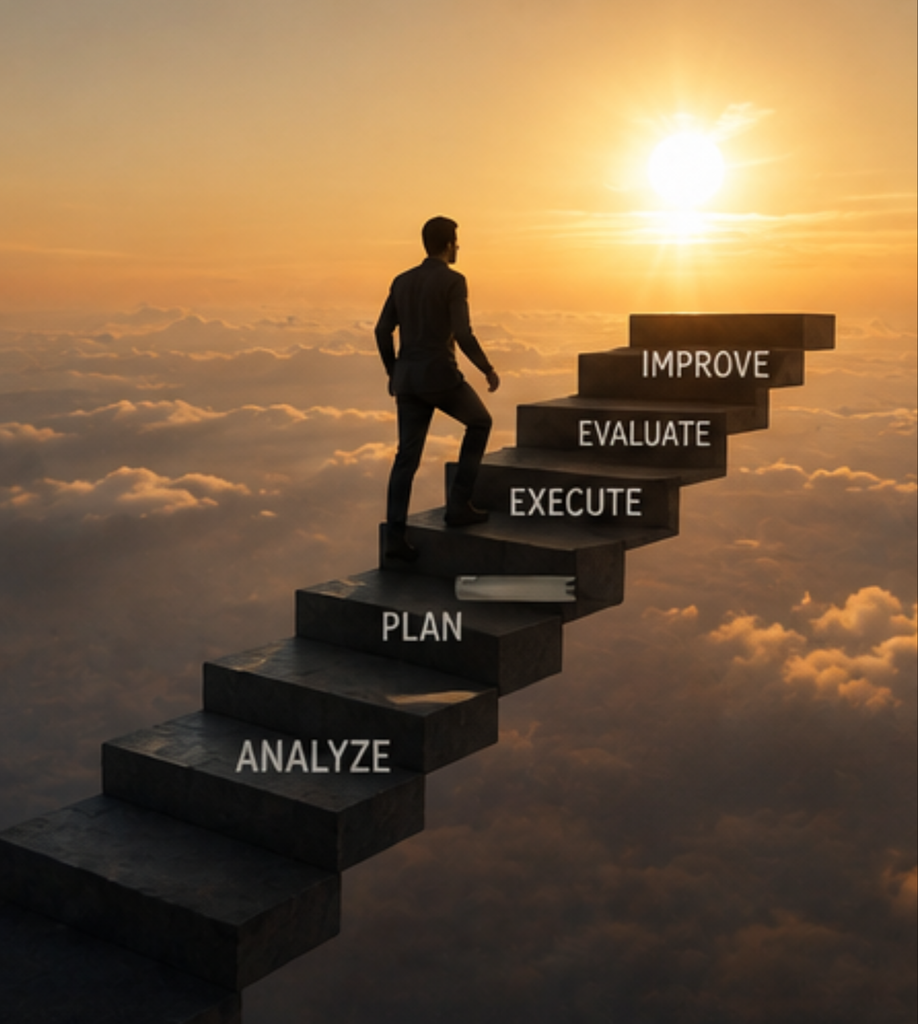
The Architecture of Truth

There is a fundamental distinction between believing something and knowing something.

Belief is psychologically natural. Knowledge is epistemically demanding.

A Philosophical Inquiry into Knowledge, Evidence, Belief and the Limits of Certainty

Prabhash Chandra

Human beings have always lived between two conditions: the world as it is and the world as they understand it. The distance between these two constitutes one of the deepest problems of human existence.

We see, interpret, remember, infer, believe and act. We construct explanations from incomplete evidence and then live according to those explanations. Civilisations are built upon them; institutions are governed by them; sciences advance by challenging them; religions interpret existence through them; and individuals make the most consequential decisions of their lives because of them.

Yet beneath all these activities lies a deceptively simple question:

What is true?

The question appears elementary only until one attempts to answer it.

Is truth correspondence with an external reality? Is it coherence within a system of propositions? Is it something established through empirical verification? Is it revealed through consciousness? Is it mediated by language? Is it dependent upon the observer? Or does truth exist independently of our capacity to recognise it?

The history of philosophy may, in one sense, be understood as the history of humanity’s struggle with these questions.

But truth is not merely an abstract concern of philosophers. Every practical decision presupposes some conception of reality. A physician acts according to a diagnosis. A teacher acts according to an understanding of learning. A judge acts according to an interpretation of evidence. A scientist acts according to a model of nature. A leader acts according to an understanding of an organisation. An individual chooses a career, a relationship, an investment or a course of action according to assumptions about what is real, possible and desirable.

If the understanding is defective, action may be defective even when the intention is good.

The question of truth, therefore, is also a question of human action.


Truth Begins Where Certainty Ends

There is a fundamental distinction between believing something and knowing something.

Belief is psychologically natural. Knowledge is epistemically demanding.

A person may believe that an event will occur tomorrow. The event may indeed occur, but the correctness of the belief does not by itself establish knowledge. A person may strongly believe that a colleague is dishonest, but intensity of conviction does not convert suspicion into evidence. A person may be certain that a particular policy will succeed, yet certainty itself provides no guarantee of success.

Human beings frequently confuse psychological certainty with epistemic justification.

The distinction matters because confidence is a property of the believer, whereas truth is a property of the proposition.

I can be completely confident and completely wrong.

History offers countless examples of individuals and societies that were profoundly certain about propositions later shown to be mistaken. The geocentric model of the universe, racial theories presented as biological fact, medical practices once regarded as unquestionably sound, and innumerable political and social assumptions demonstrate the same epistemic lesson:

The sincerity of a belief does not determine its truth.

Nor does the antiquity of a belief.

Nor its popularity.

Nor the authority of the person who expresses it.

Truth requires a relationship between claim, evidence and justification.

This is where epistemology begins.


The Ancient Question of How We Know

The Indian philosophical tradition developed sophisticated discussions concerning the nature and sources of valid knowledge. The concept of pramāṇa occupies a central position in classical Indian epistemology: by what means does cognition become valid knowledge?

Different philosophical schools accepted different pramāṇas and disagreed profoundly about their scope, reliability and metaphysical implications. Nyāya, for instance, developed an elaborate logical and epistemological framework involving perception (pratyakṣa), inference (anumāna), comparison (upamāna) and testimony (śabda), while other traditions adopted different epistemic positions.

The significance of this intellectual heritage is not that it provides a ready-made modern scientific method. Such a claim would be historically and philosophically careless.

Its significance is deeper.

Indian thinkers recognised that knowledge has conditions.

We do not simply “have” knowledge. We acquire cognition through particular means, and those means can succeed or fail.

This is a remarkably modern question:

What makes a cognition trustworthy?

The question forces us to examine the route through which a conclusion has been reached rather than merely examining the conclusion itself.

That distinction remains fundamental today.


Perception Is Not Reality

Among the most immediate sources of human knowledge is perception.

We see the world, hear it, touch it, smell it and experience it.

Yet perception is not infallible.

An optical illusion can cause a perfectly functioning visual system to produce an inaccurate interpretation. Atmospheric conditions distort distant objects. Context changes perception. Attention determines what enters conscious awareness. Memory alters subsequent reconstruction of experience.

The philosophical implication is significant.

Perception is indispensable, but it is not identical with reality.

There is therefore a difference between:

“I perceived X”

and

“X is necessarily as I perceived it.”

The first is a report about experience.

The second is a claim about reality.

The distinction becomes even more important when the object of observation is another human being.

A person remains silent.

The silence is observable.

But the reason for the silence is not directly observable.

We may infer anger.

Perhaps it is sadness.

Perhaps embarrassment.

Perhaps fatigue.

Perhaps concentration.

Perhaps nothing significant at all.

The event and the interpretation are different epistemic objects.

Much human conflict begins when interpretations are unconsciously promoted to the status of facts.


Inference and the Architecture of Explanation

Human beings cannot function through perception alone. We constantly infer.

We see dark clouds and infer rain.

We see smoke and infer fire.

We observe a pattern in data and infer a relationship.

Inference allows us to move beyond what is immediately given.

But inference introduces another possibility of error.

A conclusion can be logically constructed from insufficient or misleading premises.

The ground may be wet because it rained.

It may also be wet because someone used a hose.

A student’s performance may be poor because of inadequate effort.

It may instead result from conceptual gaps, ineffective instruction, anxiety, illness, language barriers or a combination of factors.

Thus, the problem is not simply whether an explanation is possible.

The epistemically important question is:

Is this explanation better supported than its alternatives?

This is the foundation of rational diagnosis.


From Correlation to Causation

Few errors are more common in human reasoning than confusing correlation with causation.

Two phenomena occur together, and the mind immediately constructs a causal narrative.

Yet a statistical relationship does not, by itself, establish a causal mechanism.

If students who read more books perform better academically, several explanations may coexist. Reading may contribute directly to achievement. But students with stronger language skills may also be more likely to read. Family environment may influence both reading and academic performance. Socioeconomic variables may influence both.

The observed relationship may be genuine while the proposed explanation remains incomplete.

This is why rigorous inquiry requires more than finding patterns.

It requires identifying mechanisms.

The question changes from:

“What occurs with what?”

to:

“Through what process does one condition influence another?”

That movement—from association to mechanism—is one of the defining characteristics of mature reasoning.


The Problem of the Observer

Modern science often attempts to isolate the observer from the phenomenon being observed.

Human systems complicate this ambition.

In education, management, politics and social life, the observer is often part of the system.

A teacher’s expectations influence student behaviour.

A leader’s communication alters organisational culture.

A parent’s response influences a child’s future response.

A researcher’s framing can influence how participants respond.

An administrator’s policy changes the behaviour of the very people being evaluated.

Thus, in complex human systems, the observer cannot always be treated as an external spectator.

This creates an important philosophical problem:

How much of what we observe is produced by the system, and how much is produced by our way of observing it?

The question leads naturally toward metacognition.

Before examining the object, perhaps we must sometimes examine the instrument of examination.

And in human inquiry, that instrument is partly ourselves.


The Self as an Epistemic Variable

The Indian philosophical tradition repeatedly turns the question of knowledge back toward the knower.

The Upanishadic inquiry into ātman, consciousness and the nature of the self is not merely an exercise in metaphysical speculation. It raises a fundamental epistemological problem:

Who is the knower?

The question “Who am I?” therefore acquires a philosophical significance far beyond personal identification.

If the knower is affected by desire, fear, memory, attachment, social conditioning and prior belief, then the acquisition of knowledge cannot be entirely separated from the condition of the knower.

This does not mean that objective knowledge is impossible.

It means that epistemic discipline requires awareness of the conditions under which knowing occurs.

A frightened mind sees danger differently from a calm mind.

An ego-defensive mind interprets criticism differently from an open mind.

A person deeply attached to a conclusion evaluates evidence differently from someone genuinely willing to revise it.

The quality of reasoning is therefore partly dependent upon the quality of the reasoner.


“Neti, Neti” and Epistemic Restraint

The Upanishadic expression “neti, neti”—“not this, not this”—has traditionally been interpreted within a profound metaphysical framework. It should not be reduced to a modern problem-solving technique.

Yet as a philosophical metaphor, it offers an important lesson about epistemic restraint.

The human mind tends to identify reality too quickly with its first available description.

We name something and believe that we have understood it.

We classify something and assume that the classification exhausts its nature.

We construct an explanation and become attached to it.

“Neti, neti” can be read, cautiously, as a reminder that the map should not be confused with the territory.

Every conceptual description is partial.

Every model has a domain of validity.

Every theory has assumptions.

Every explanation leaves something unexplained.

This is not a weakness of knowledge.

It is a condition of finite knowledge.


Science and the Virtue of Revision

The strength of science lies not in possessing infallible conclusions but in possessing institutionalised mechanisms for correction.

A scientific hypothesis must be vulnerable to evidence.

A theory gains strength through explanatory power, predictive success, empirical support and resistance to serious attempts at falsification and refutation.

Scientific knowledge is therefore provisional—not because it is arbitrary, but because it remains open to revision when better evidence or better explanations emerge.

This is a crucial distinction.

Provisional does not mean unreliable.

It means revisable in principle.

A scientific proposition is stronger precisely because it is not protected from criticism.

This intellectual structure has an important implication for everyday reasoning.

We should not ask merely:

“How can I prove that I am right?”

We should also ask:

“What evidence could demonstrate that I am wrong?”

The second question is often more intellectually valuable.


The Psychology of Being Right

Human beings are not purely rational information-processing systems.

We are emotional, social and identity-bearing creatures.

We do not merely hold beliefs.

We often become attached to them.

A political belief can become part of identity.

A professional opinion can become a matter of reputation.

A religious interpretation can become intertwined with belonging.

A management decision can become associated with personal competence.

Once a belief becomes part of identity, evidence against it may feel like a personal attack.

This produces confirmation bias.

We search selectively.

We remember selectively.

We interpret selectively.

We notice supporting evidence more readily than contradictory evidence.

The danger is subtle because confirmation bias does not require dishonesty.

A person can sincerely believe that he is being objective while unconsciously selecting information that confirms what he already believes.

The remedy is not complete objectivity—which may be an unrealistic ideal—but procedural safeguards against our own biases.

Seek disconfirming evidence.

Invite disagreement.

Compare alternative explanations.

Separate evidence from interpretation.

Record predictions before outcomes are known.

Review decisions after results become available.

These practices do not eliminate human bias.

They make bias more visible and therefore more manageable.


The Question of Authority

Human civilisation depends upon trust.

No individual can independently verify every scientific claim, every historical fact or every technical proposition.

We therefore depend upon experts.

This dependence is not irrational.

It is a practical necessity.

But rational trust is different from intellectual submission.

The relevant question is not:

“Is this person an authority?”

It is:

“Is this person a reliable authority on this particular question, and what is the basis of that reliability?”

Expertise is domain-specific.

A distinguished physicist is not automatically an authority on constitutional law.

A brilliant mathematician is not necessarily an expert in clinical psychology.

A successful entrepreneur is not automatically an expert in educational science.

Authority deserves respect.

But claims deserve evaluation.


Tradition, Reason and the Discipline of Neither Blind Acceptance Nor Blind Rejection

Tradition presents another epistemic challenge.

The fact that an idea has survived for centuries does not prove its universal truth.

But the fact that an idea is ancient does not make it irrational either.

Traditions are repositories of accumulated human experience. Some contain enduring insights. Others are context-dependent. Some contain symbolic wisdom. Others may reflect historical limitations.

The rational response is neither uncritical acceptance nor fashionable dismissal.

It is examination.

What was the original context?

What problem did the idea address?

What assumptions underlie it?

What remains philosophically defensible?

What is empirical?

What is metaphysical?

What is symbolic?

What is historical?

Such discrimination is itself an expression of Viveka.


Viveka: The Discipline of Distinction

Few concepts are more valuable to rational thought than discernment.

Viveka can be understood broadly as the capacity to distinguish.

In practical epistemology, we need to distinguish:

fact from interpretation,

evidence from assertion,

cause from correlation,

possibility from probability,

probability from certainty,

authority from expertise,

tradition from truth,

emotion from evidence,

and confidence from competence.

Without such distinctions, the mind collapses categories that should remain separate.

With them, thought becomes more precise.

Perhaps this is why intellectual maturity is less about knowing more and more about distinguishing better.


The Bhagavad Gita: Knowledge as Transformation

The Bhagavad Gita presents knowledge not as mere accumulation of propositions but as something capable of transforming the orientation of the individual.

Arjuna’s crisis is not resolved simply by receiving additional information. The dialogue addresses his understanding of duty, action, attachment, selfhood and consequence.

This suggests an important distinction between information and wisdom.

Information can tell us what something is.

Knowledge can organise information.

Understanding can reveal relationships and causes.

Discernment can identify what matters.

Wisdom determines how understanding should shape action.

Thus:

Knowledge becomes wisdom when it changes the quality of judgement.

A person can possess extensive information and still make poor decisions.

The problem is not always informational deficiency.

It may be a deficiency of judgement.


Action Under Uncertainty

The Bhagavad Gita also offers a profound meditation on action under conditions where outcomes cannot be completely controlled.

The well-known verse,

“Karmaṇy-evādhikāras te mā phaleṣu kadācana”

is commonly interpreted as emphasising one’s responsibility for action without unhealthy attachment to the fruits of action.

A modern reading should not reduce this teaching to a simplistic productivity slogan.

Its philosophical depth lies partly in the distinction between agency and outcome.

Human beings can control some conditions.

They cannot control all consequences.

We can prepare for an examination, but not completely determine the questions.

We can make a responsible decision, but not completely control the environment in which it operates.

We can communicate carefully, but not entirely control another person’s interpretation.

The rational response to such uncertainty is neither fatalism nor illusion of total control.

It is disciplined agency.


Uncertainty Is Not Ignorance

Modern decision-making often struggles with uncertainty because human beings prefer binary categories.

True or false.

Success or failure.

Safe or dangerous.

Right or wrong.

But reality frequently exists in probabilistic states.

A scientific prediction can be highly probable without being certain.

A diagnosis can be strongly supported without being infallible.

A strategic decision can be rational without being guaranteed to succeed.

Therefore, intellectual maturity requires the ability to represent uncertainty honestly.

There is an important difference between:

“This is certain.”

and

“The evidence currently makes this the most probable explanation.”

The second statement may sound less decisive.

Epistemically, it is often stronger.

It acknowledges the possibility of revision.


Risk and the Consequences of Error

Not every uncertainty deserves the same degree of investigation.

If we are uncertain about which film to watch, the cost of error is trivial.

If we are uncertain about a major financial decision, the cost is greater.

If we are uncertain about a medical intervention, the consequences may be substantial.

Therefore, rational decision-making must consider not only probability, but also consequence.

This is the logic of risk.

A low-probability event with catastrophic consequences may deserve more attention than a high-probability event with negligible consequences.

Thus, epistemology eventually becomes decision theory.

The question of what is true becomes connected to the question:

What should I do given what I know, and given what I do not know?


The Architecture of Evidence

Evidence is not a single category.

There are observations, measurements, experiments, statistical associations, historical records, expert testimony, personal experiences and theoretical deductions.

Their reliability depends upon context.

An anecdote may provide a meaningful clue but cannot necessarily establish a general law.

A large dataset may reveal a strong pattern but still be vulnerable to sampling bias.

An experiment may establish causality under controlled conditions but have limited external validity.

An expert opinion may be valuable but must be distinguished from empirical evidence.

Therefore, evidence must itself be interrogated.

What is the source?

How was the evidence generated?

What assumptions were involved?

What limitations exist?

Could another explanation account for the same observation?

This is the architecture of rational inquiry.


Information in the Age of Algorithms

The epistemic problem has become more difficult in the digital age.

We no longer suffer primarily from scarcity of information.

We suffer from abundance.

Search engines, social media platforms and recommendation systems continuously select information for us.

The result can be intellectually dangerous.

We may encounter more of what we already believe.

The algorithm learns our preferences.

Our preferences shape what we consume.

What we consume reinforces our preferences.

The result is a feedback loop.

A person can therefore experience a highly personalised information environment and mistake it for reality itself.

The solution is not to reject technology.

It is to become more deliberate about epistemic diversity.

Read beyond ideological comfort.

Consult primary sources when possible.

Distinguish evidence from commentary.

Compare competing explanations.

Verify extraordinary claims.

And remain conscious of the fact that the information environment itself is not neutral.


Disagreement as a Test of Knowledge

A belief that has never encountered serious criticism has not necessarily been validated.

It may simply have been protected.

Intellectual disagreement can therefore serve a constructive purpose.

A rigorous critic identifies hidden assumptions.

An opposing model reveals neglected variables.

A contrary interpretation tests explanatory strength.

This is why serious intellectual traditions cultivate debate.

The purpose of disagreement should not be victory.

It should be epistemic stress-testing.

A proposition that survives serious criticism becomes more credible—not because criticism makes it true, but because plausible alternatives have been examined.


From Problem-Solving to Truth-Seeking

The connection with the previous article now becomes clear.

Problem-solving begins with the identification of a gap between reality and desired conditions.

But before solving the gap, we must establish what the current reality actually is.

This requires observation.

Then we require interpretation.

Then causal analysis.

Then evidence.

Then alternative hypotheses.

Then intervention.

Then measurement.

Then revision.

This is why methodologies such as PDCA and SDLC are more philosophically significant than they may initially appear.

PDCA institutionalises the principle that action must be followed by evaluation and correction.

SDLC institutionalises the principle that systems require requirements analysis, design, testing, deployment and maintenance.

Both embody an important epistemic humility:

Our first model may be incomplete. Therefore, reality must be allowed to correct the model.

That is the essence of rational practice.


The Difference Between Explanation and Understanding

An explanation tells us why we think something happens.

Understanding goes further.

It reveals the structure within which the phenomenon occurs.

Suppose an organisation experiences declining productivity.

An explanation may say:

“Employees are not sufficiently motivated.”

Understanding asks:

What are the incentives?

How are responsibilities distributed?

How is performance measured?

What information is available?

Where do bottlenecks occur?

What behaviours does the system reward?

What behaviours does it unintentionally punish?

What feedback loops exist?

What historical decisions created the present structure?

The second approach is slower.

But it is more likely to reveal the architecture of the problem.


When the Model Becomes the Prison

Every intellectual model simplifies reality.

That is necessary.

A map that contained every detail of the territory would be the territory itself.

Models are useful because they exclude information.

But the same feature that makes a model useful can make it dangerous.

If we forget that the model is a simplification, we begin forcing reality to conform to it.

This happens in management, economics, education, politics and even science.

A metric becomes the objective.

A category becomes an identity.

A theory becomes doctrine.

A procedure becomes more important than its purpose.

The model becomes the prison.

The mature thinker therefore asks periodically:

“What does my model fail to explain?”

That question is often more valuable than asking what the model explains.


The Limits of Certainty

Human knowledge is finite.

Reality is not obliged to fit within the limits of our current understanding.

This does not imply relativism.

The statement “we do not know everything” does not imply “anything could be true.”

There remains a crucial distinction between:

uncertainty

and

arbitrariness.

We can have incomplete knowledge while still possessing strong evidence.

We can recognise uncertainty while maintaining justified conclusions.

We can reject absolute certainty without surrendering rational standards.

This middle position is intellectually demanding.

It avoids both dogmatism and nihilism.


From Knowledge to Wisdom

Perhaps the progression can now be stated more precisely.

Information gives us data.

Knowledge organises data into justified propositions.

Understanding reveals relationships, mechanisms and context.

Discernment distinguishes what is significant from what is incidental.

Judgement determines what should be done.

Experience reveals consequences.

Wisdom integrates knowledge, judgement, consequence and ethical responsibility.

Thus, wisdom is not simply the possession of more information.

It is the ability to use knowledge appropriately within the complexity of life.


The Ethical Dimension of Truth

Truth-seeking without ethical responsibility can become dangerous.

Human beings have developed extraordinary capacities to discover what can be done.

The harder question is what ought to be done.

Technology can tell us what is technically possible.

It cannot, by itself, determine what is morally desirable.

Data can reveal patterns.

It cannot alone determine values.

Efficiency can reduce waste.

It cannot alone establish justice.

Profit can measure financial return.

It cannot alone determine social worth.

Thus, rationality requires a dialogue between epistemology and ethics.

The question of truth must eventually meet the question of value.


Truth and Dharma

This is where the concept of Dharma can enter the discussion—not as a simplistic equivalent of “morality,” but as a complex concept concerning order, duty, right conduct and the sustaining principles appropriate to a context.

The philosophical significance is that correct action cannot be determined solely by technical effectiveness.

A decision may be efficient and still be wrong.

A policy may produce the desired metric and still undermine human dignity.

A solution may solve one problem while creating a larger one.

Therefore, the final test of knowledge is not merely:

Does it work?

It is also:

What does it produce, for whom, and at what cost?

This is where responsible problem-solving becomes wisdom.


The Final Measure of Knowledge

Perhaps the deepest test of knowledge is not how confidently we can defend it.

It is how responsibly we can act upon it.

A person who knows the limits of his knowledge is often more reliable than one who claims certainty without justification.

A leader who says “I do not yet know” may be more trustworthy than one who provides an immediate but unsupported answer.

A scientist who publishes limitations demonstrates greater intellectual integrity than one who hides uncertainty.

A teacher who changes an approach after evidence shows that it is ineffective demonstrates greater professionalism than one who protects a familiar method merely because it has always been used.

Knowledge becomes credible when it remains answerable to reality.


Conclusion: Truth as a Discipline

The search for truth is not merely a search for conclusions.

It is a discipline of how we arrive at conclusions.

It requires us to distinguish perception from interpretation, inference from observation, correlation from causation, belief from knowledge, authority from evidence, possibility from probability, and confidence from certainty.

The Indian philosophical traditions remind us that knowledge has means and conditions. Pramāṇa asks how valid knowledge is established. Viveka asks us to distinguish. Svadhyaya turns inquiry toward the knower. The Upanishadic tradition challenges us to examine the foundations of our understanding. The Bhagavad Gita connects knowledge with action, responsibility and disciplined agency.

Modern science contributes another indispensable discipline: the willingness to be corrected by evidence.

Systems thinking reminds us that phenomena exist within relationships.

Critical thinking reminds us to interrogate assumptions.

PDCA reminds us to learn through feedback.

SDLC reminds us that every constructed system requires testing, maintenance and adaptation.

These are not identical philosophies, nor should they be artificially merged into one system.

But they converge upon a powerful intellectual principle:

Reality must have the final authority over our explanations of reality.

We may begin with a hypothesis.

We may construct a model.

We may hold a belief.

We may formulate a theory.

But if reality persistently contradicts it, intellectual integrity requires revision.

Perhaps, then, wisdom begins with a simple admission:

I may not know.

From that admission comes inquiry.

From inquiry comes evidence.

From evidence comes knowledge.

From knowledge comes understanding.

From understanding comes discernment.

From discernment comes responsible action.

And from action comes experience—the feedback through which knowledge is tested against life itself.

The journey is therefore not:

Belief → Certainty.

It is:

Question → Inquiry → Evidence → Understanding → Discernment → Action → Feedback → Revision.

And the cycle continues.

Truth, in this sense, is not merely something we possess.

It is something we approach through disciplined inquiry.

Perhaps the most intellectually honest person is not the one who has an answer for every question.

It is the one who knows:

what is known,
what is unknown,
why something is believed,
what evidence supports it,
what could disprove it,
and when the courage to revise is greater than the comfort of being right.

For ultimately, the search for truth is not a contest between certainty and doubt.

It is a movement from unexamined belief toward justified understanding.

And perhaps the architecture of truth is never completed.

It is built continuously—

by observation,

by reason,

by evidence,

by criticism,

by reflection,

by experience,

and, above all,

by the willingness to ask one question again and again:

“How do I know?”

Because sometimes the most profound discovery is not the truth we find.

It is the recognition of how much more carefully we must learn to seek it.

— Prabhash Chandra

The Questions We Ask Shape the Worlds We See

A Philosophical Inquiry into Inquiry, Perception, Assumptions and the Search for Truth

Prabhash Chandra

We often believe that the greatest human achievement is finding the right answer. Perhaps it is not. Perhaps the greater achievement is learning to ask the right question.

A wrong answer to a wrong question may produce nothing more than an elaborate mistake. A good question, on the other hand, can disturb certainty, expose assumptions, reorganise thought and open an entirely new path of understanding. Almost every significant intellectual transformation in human history has begun with a question. The child asks, “Why?” The scientist asks what causes a phenomenon. The philosopher asks what truth is. The engineer asks how something can be made to work. The physician asks what lies behind a symptom. The teacher asks what prevents a learner from understanding. The leader asks what prevents an organisation from fulfilling its purpose.

And eventually, the reflective human being asks perhaps the most uncomfortable question of all:

What am I not seeing?

That question is important because our greatest limitation is not always a lack of information. Sometimes it is the framework through which we interpret information. We may possess facts and still misunderstand reality. We may have data and still reach the wrong conclusion. We may have experience and yet continue to repeat the same mistake. The problem, therefore, is not always the absence of knowledge. Sometimes the problem is the architecture of our thinking.

This is where the philosophy of problem-solving begins.

In my previous reflection, From the Labyrinth of Chaos to the Architecture of Clarity, I considered the problem of navigating complexity through systematic inquiry, root-cause analysis, systems thinking, SDLC, PDCA and the wisdom traditions of India. But every methodology of problem-solving eventually leads us to a deeper question: How do we know that the problem we are trying to solve is actually the problem?

That question changes everything.

We often assume that what we see is what exists. Yet seeing and understanding are not the same thing. A teacher may see a child who is not completing assignments and conclude that the child is careless. A manager may see declining productivity and conclude that employees lack motivation. A parent may see disobedience and conclude that a child lacks discipline. An organisation may see repeated errors and conclude that an employee is incompetent.

But the visible event is not necessarily the underlying cause.

The student may be struggling because foundational concepts are weak. The employee may be struggling because the process is badly designed. The child may be resisting because communication has broken down. The organisation may be producing errors because its procedures make those errors almost inevitable.

The observation may be correct while the interpretation is wrong.

This distinction between what is observed and what is inferred is one of the foundations of rational thinking.

Whenever we encounter a difficult situation, perhaps we should pause before searching for a solution and ask three simple questions:

What do I actually know? What do I believe? What am I assuming?

These three categories are frequently mixed together. A statement such as “the student is not interested in learning” may sound like an observation, but it is actually an interpretation. What we may really know is that the student is not completing assignments or is performing poorly in an assessment. The reason may remain unknown.

This distinction may appear small, but it has enormous consequences. If we confuse interpretation with fact, our intervention may be directed toward the wrong target. We may attempt to correct behaviour when the real problem is understanding. We may increase supervision when the real problem is process design. We may impose discipline when the real problem is communication.

A problem incorrectly defined is already halfway toward an incorrect solution.

This is why asking “Why?” remains one of the most powerful instruments of human reasoning.

A student performs poorly. Why? Perhaps because the student does not practise. Why? Perhaps because the student finds the questions difficult. Why? Perhaps because foundational concepts are weak. Why? Perhaps because earlier learning was not adequately consolidated. The problem has now changed. It is no longer simply a question of effort. It has become a question of foundational learning.

The same logic applies to organisations, relationships, technology, economics and almost every complex human system.

The visible problem is often only the surface of a deeper structure.

This is precisely why Root Cause Analysis is more valuable than premature judgement. A symptom tells us where to look. It does not necessarily tell us what to change.

A fever tells us that something is wrong in the body, but fever itself is not necessarily the disease. A warning light tells us that a system has detected a problem, but the warning light is not necessarily the mechanical failure. Low examination marks indicate an outcome, but they do not by themselves explain the learning deficit. Declining sales reveal a business problem, but they do not automatically identify its cause.

The wise problem solver therefore asks not merely, “What happened?” but “What produced what happened?”

And then another question follows:

What keeps reproducing it?

That question takes us from isolated events to systems.

Human beings naturally prefer linear explanations. We like to believe that A caused B. But complex systems rarely behave so simply. A influences B, B influences C, C changes D, and D eventually returns to influence A. This produces feedback loops.

Low confidence can lead to low effort. Low effort can lead to poor performance. Poor performance can further reduce confidence. A cycle is created.

Poor communication can create misunderstanding. Misunderstanding can create conflict. Conflict can reduce communication. Reduced communication can create further misunderstanding.

Declining sales can reduce investment. Reduced investment can affect quality. Lower quality can reduce customer trust. Reduced trust can further reduce sales.

In such situations, the problem is not located in a single event. It exists in the relationship between events.

This is the essence of Systems Thinking.

It also explains why a solution that appears effective at one level may produce unintended consequences at another. A school may increase homework in the hope of improving achievement, only to discover that students become exhausted and disengaged. An organisation may increase monitoring to improve productivity, only to create distrust. A business may reduce costs to improve profitability, only to damage the quality that customers value.

Every intervention changes a system.

Therefore, the mature question is not merely:

“What can I change?”

It is:

“What else will change if I make this change?”

That is the beginning of systemic intelligence.

The importance of questioning is not a discovery of modern management alone. The Indian intellectual tradition has always given extraordinary importance to inquiry. The Upanishadic tradition, in particular, is filled with questions concerning reality, knowledge, consciousness, the self, causation and existence.

The question “Ko’ham?”—Who am I? is not merely a question about one’s name or social identity. It is an invitation to investigate the nature of the self.

This tradition teaches us something that modern problem-solving sometimes forgets: before attempting to understand the world, we may need to examine the mind that is attempting to understand the world.

A biased observer can misinterpret evidence. An anxious decision-maker can exaggerate danger. An ego-driven leader can reject inconvenient information. A person attached to a particular conclusion can unconsciously search only for evidence that confirms it.

Thus, the observer is sometimes part of the problem.

This is particularly important in human systems. A teacher changes a classroom through expectations. A leader changes an organisation through decisions and incentives. A parent changes a child’s behaviour through responses. A researcher may influence the conditions being studied. In human affairs, the observer cannot always stand completely outside the system being observed.

The problem, therefore, may exist partly in the system and partly in the way we perceive the system.

The Upanishadic idea of “Neti, neti”, commonly rendered as “not this, not this,” offers an interesting philosophical analogy. It represents a disciplined refusal to identify ultimate reality too quickly with any limited description. In the context of inquiry, there is an important methodological lesson: do not become prematurely attached to the first explanation.

Perhaps this is also how scientific thinking advances.

Science begins not with absolute certainty but with curiosity. Observation produces a question. The question produces a hypothesis. The hypothesis is tested. Evidence supports, modifies or rejects the hypothesis. Understanding develops through repeated revision.

The great strength of scientific thinking lies not merely in its ability to produce explanations but in its willingness to abandon explanations when evidence demands it.

This requires intellectual humility.

An idea is not an identity.

A hypothesis is not a possession.

Being proven wrong is not necessarily intellectual failure. Sometimes it is intellectual progress.

One of the most dangerous habits of the human mind is confirmation bias—our tendency to notice evidence that supports what we already believe and to discount evidence that challenges us.

A teacher who has already decided that a student is weak may notice every mistake while overlooking improvement. A manager who believes an employee is careless may interpret every delay as evidence of negligence while ignoring circumstances that explain the delay. A leader convinced that a particular strategy is working may reinterpret negative evidence as temporary difficulty.

The solution is not to pretend that human beings can become completely free from bias. The more realistic objective is to create habits of thinking that expose us to evidence capable of challenging our assumptions.

One of the most powerful questions we can ask ourselves is:

What evidence would prove me wrong?

That question is uncomfortable precisely because it opens the door to intellectual correction.

Another useful question is:

What if the opposite were true?

Suppose we believe that employees are underperforming because they lack motivation. What if the real problem is process design? Suppose we believe students are weak because they do not study. What if they do not study because they do not understand? Suppose we believe a project is delayed because the team is inefficient. What if the requirements themselves are continuously changing?

Counterfactual thinking disrupts intellectual comfort. It forces us to examine alternative explanations.

This is why better questions often produce better solutions.

Instead of asking, “Why am I failing?” we might ask, “Which behaviour or strategy is producing my current outcome?”

Instead of asking, “Why is my organisation inefficient?” we might ask, “Where does information, time or responsibility become unnecessarily delayed?”

Instead of asking, “Why don’t people listen to me?” we might ask, “What in my communication may be reducing clarity or trust?”

Instead of asking, “Why do students not perform?” we might ask, “Which prerequisite competencies are missing?”

Instead of asking, “Why does this problem keep returning?” we might ask, “What feedback loop is reproducing it?”

Instead of asking, “Who is responsible?” we might ask, “What combination of individual, process and systemic factors produced this outcome?”

These questions do not merely collect information. They determine the direction of investigation.

This is where the idea of Viveka, or discernment, becomes particularly relevant. Knowledge gives us information. Discernment helps us determine what matters.

We need to distinguish fact from assumption, signal from noise, cause from correlation, urgency from importance, short-term relief from long-term resolution, and efficiency from effectiveness.

A technically possible solution may not be a wise solution.

A profitable decision may not be an ethical decision.

A quick intervention may not be a sustainable intervention.

A solution that improves one metric may damage the larger system.

Thus, problem-solving cannot be separated entirely from ethics.

The Bhagavad Gita offers an enduring reflection on this problem through the crisis of Arjuna. Arjuna is not merely asking what action is possible. He is struggling with what action is appropriate when every available choice carries consequences.

Krishna’s response is not simply an instruction to act. The dialogue transforms Arjuna’s understanding of duty, knowledge, action, attachment and responsibility.

This offers an important insight for contemporary problem-solving:

Sometimes the most powerful intervention is not a change in circumstances but a transformation in the framework through which circumstances are understood.

The external situation may remain the same while the quality of our response changes completely.

The Gita’s teaching on action also reminds us of the distinction between agency and outcome. We can control preparation more directly than examination results. We can control the quality of a decision more directly than every consequence of that decision. We can control our communication more directly than another person’s interpretation.

This is not an argument for passivity. It is an argument for disciplined action under uncertainty.

The modern language of continuous improvement expresses a similar practical discipline through the PDCA cycle—Plan, Do, Check, Act.

We plan according to what we currently understand. We act. Reality responds. We check the result. We learn. We modify the next action.

The profound insight here is that action itself produces information.

We do not always learn before acting.

Sometimes we learn because we act.

A small experiment can reveal what a hundred theoretical discussions cannot.

This principle is equally visible in the Software Development Life Cycle. Requirements are understood. The system is analysed and designed. It is developed, tested, deployed and maintained. Testing exists because design assumptions can be wrong. Maintenance exists because no solution remains permanently adequate in a changing environment.

The lesson extends far beyond software:

A solution is not complete merely because it works once. It is complete when it remains useful under changing conditions.

This is why adaptability is becoming increasingly important in every field.

We cannot guarantee the future.

We cannot control every human response.

We cannot control every market condition.

We cannot control every technological development.

We cannot control every consequence of our decisions.

Therefore, the objective of intelligent action cannot be total control.

It must be responsible influence under conditions of uncertainty.

This is a more realistic and mature understanding of human agency.

Perhaps this is also where Chaos Theory becomes philosophically relevant. A chaotic system is not simply random disorder. It may possess underlying deterministic rules while remaining highly sensitive to initial conditions. A small difference can eventually produce a dramatically different trajectory.

The metaphor is useful beyond mathematics.

A small habit can become a defining character trait.

A small communication gap can become a major conflict.

A small quality issue can become a loss of trust.

A small administrative negligence can eventually become an institutional problem.

We tend to notice dramatic consequences, but systems are often shaped by small beginnings.

Therefore, the wise person learns to respect small causes.

Yet the opposite lesson is equally important. Not every small event is significant. Complexity means that we must distinguish meaningful signals from noise. This again brings us back to discernment.

The challenge is not simply to collect more information.

It is to identify which information matters.

This is perhaps one of the greatest challenges of our age. We live in an environment of extraordinary information abundance, but information alone does not produce wisdom.

Information tells us what is available.

Knowledge organises information.

Understanding connects knowledge with causes and consequences.

Judgement determines what should be done.

Wisdom understands not only what can be done, but what ought to be done.

The progression might therefore be expressed as:

Information → Knowledge → Understanding → Discernment → Action → Experience → Wisdom.

Wisdom cannot simply be downloaded.

It must be cultivated through reflection and experience.

This is why failure, when approached intelligently, can become an instrument of learning.

When a solution fails, we should not immediately conclude that the entire effort was meaningless. Perhaps the diagnosis was incorrect. Perhaps the intervention was insufficient. Perhaps implementation was flawed. Perhaps the system adapted. Perhaps an unintended consequence emerged. Perhaps the environment changed.

Failure is information.

The important question is what we do with that information.

A failed experiment can become a successful lesson.

A failed intervention can improve the next intervention.

A wrong hypothesis can bring us closer to a better one.

The intelligent response to failure is therefore not always repetition.

It is revision.

This is where problem-solving becomes a form of continuous learning.

The human being can be understood as an adaptive system. We receive information, form interpretations, act upon those interpretations, encounter consequences, receive feedback and revise our understanding.

This is learning.

The danger begins when the feedback is rejected.

An individual who refuses to learn from experience becomes trapped in recurring patterns. An organisation that refuses feedback becomes rigid. A thinker who refuses correction becomes dogmatic.

Learning requires something more difficult than intelligence.

It requires the courage to allow reality to contradict us.

Perhaps this is why intellectual humility is one of the highest forms of intelligence.

The ability to say, “I may be wrong,” is not weakness.

The ability to say, “I need more evidence,” is not indecision.

The ability to say, “I had not considered that possibility,” is not ignorance.

These are signs that the mind remains open to reality.

A closed mind protects conclusions.

An open mind protects inquiry.

Yet there is another danger.

We can question endlessly.

We can analyse forever.

We can collect information indefinitely.

We can postpone action in the name of further research.

That too becomes a problem.

The purpose of inquiry is ultimately to enable better judgement and better action.

Questions should lead to understanding. Understanding should inform decisions. Decisions should lead to action. Action should produce feedback. Feedback should refine understanding.

Thus, the rhythm becomes:

Question → Understand → Decide → Act → Observe → Learn → Question again.

This is not merely a problem-solving technique.

It is a philosophy of intellectual life.

Perhaps the deepest lesson is that we do not need to possess an answer to every question. We need to understand the structure of our uncertainty.

Clarity does not mean knowing everything.

Clarity means knowing what is known, what is unknown, what is assumed, what is measurable, what is controllable, what is uncertain, what matters and what should be done next.

That is the architecture of clarity.

And clarity is never permanently finished.

It must be constructed, tested and reconstructed.

Every new experience can challenge an old assumption.

Every new piece of evidence can modify an existing model.

Every new problem can reveal a limitation in our previous understanding.

The mature thinker therefore does not ask only, “What is the answer?”

He asks:

“What is the quality of the question?”

This distinction is profound.

A narrow question creates a narrow field of possibility.

A better question opens a larger field.

A profound question can change the direction of an entire life.

Perhaps this is why the greatest intellectual traditions of humanity have placed questioning at the centre of wisdom.

The Upanishads questioned the nature of reality.

The Buddha questioned suffering and its causes.

Socrates questioned assumptions.

Scientists question phenomena.

Philosophers question concepts.

Mathematicians question patterns.

Children question everything before society teaches them which questions are acceptable.

And perhaps wisdom is partly the ability to retain that childlike curiosity while developing the intellectual discipline of an adult.

We began with a simple proposition: the questions we ask shape the worlds we see.

We can now take that proposition further.

Our questions shape what we observe.

What we observe influences what we believe.

What we believe influences what we decide.

What we decide influences how we act.

How we act produces consequences.

Those consequences provide feedback.

And feedback either reinforces or transforms our understanding.

Thus, the architecture becomes:

Observation → Question → Assumption → Inquiry → Evidence → Understanding → Discernment → Action → Feedback → Wisdom.

Perhaps this is the deeper connection between science, philosophy, systems thinking, PDCA, SDLC and the Indian traditions of inquiry. Their vocabularies are different. Their historical contexts are different. Their purposes are not identical. Yet they share a profound human impulse: the movement from uncertainty toward understanding and from understanding toward responsible action.

The real problem, therefore, is not always the problem we first notice.

The deeper problem may be the question through which we have framed it.

And sometimes the most transformative moment in problem-solving is not when we discover an answer, but when we realise that we have been asking the wrong question.

So, when the next difficult problem appears, perhaps we should resist the temptation to rush immediately toward a solution.

Pause.

Observe.

Separate fact from interpretation.

Examine assumptions.

Search for alternative explanations.

Ask what evidence would prove you wrong.

Look for patterns.

Understand the system.

Identify the leverage point.

And then ask the question beneath the question:

What is the question I should really be asking?

Because sometimes the door to the solution is not hidden behind the answer.

It is hidden inside the question.

— Prabhash Chandra

From the Labyrinth of Chaos to the Architecture of Clarity

A Philosophical Inquiry into Problem-Solving and Human Action

Prabhash Chandra


Every human life is, in some measure, an encounter with the unresolved.

There are questions without immediate answers, circumstances that resist our intentions, relationships that refuse to conform to our expectations, institutions that behave differently from the way we designed them, and decisions whose consequences cannot be completely anticipated.

We call these situations problems.

But perhaps a problem is not merely something that stands in our way.

Perhaps it is an invitation to understand.

The history of human civilisation can, in many ways, be read as a history of this encounter: the encounter between uncertainty and intelligence, disorder and order, ignorance and knowledge, action and consequence.

Science attempts to understand the structure behind phenomena.

Philosophy questions the assumptions behind our understanding.

Engineering builds mechanisms to transform intention into reality.

Management develops systems for organised action.

And human beings, across all these disciplines, continue to ask one fundamental question:

How do we move from the labyrinth of confusion to the architecture of clarity?

This question lies at the heart of problem-solving.


The Problem Before the Solution

Our first instinct when confronted with a problem is often to search for an answer.

That instinct is understandable.

It is also frequently premature.

Before asking “How do I solve this?”, we should ask:

“What exactly am I trying to solve?”

A problem can broadly be understood as a significant gap between a current state and a desired state.

But this definition, though useful, is incomplete.

The visible problem may merely be a symptom.

A student may be underperforming.

An organisation may be losing efficiency.

A project may be delayed.

A relationship may be deteriorating.

A business may be losing customers.

But these are observations, not necessarily explanations.

The deeper question is:

What structure, process, behaviour or condition is producing the observed outcome?

The distinction is crucial.

If a room is repeatedly filling with water, removing the water is not necessarily the solution.

The broken pipe may be the problem.

Likewise, if an institution repeatedly encounters the same difficulty, correcting the visible incident without examining the underlying process may simply postpone recurrence.

A mature problem solver therefore does not merely ask:

“What happened?”

He asks:

“Why did it happen?”

And then:

“Why did that condition exist?”

And then:

“What system continues to reproduce it?”


The Discipline of Asking “Why?”

One of the simplest tools of problem-solving is also one of the most powerful:

Why?

A student is performing poorly.

Why?

Because the student is not practising adequately.

Why?

Because the student finds the questions difficult.

Why?

Because foundational concepts are weak.

Why?

Because earlier learning was not consolidated.

The problem has now changed.

It is no longer simply:

“The student is not working hard.”

It has become:

“There is a foundational learning gap.”

The difference between the two diagnoses is enormous.

One invites blame.

The other invites intervention.

This is why Root Cause Analysis is more intellectually useful than premature judgement.

A solution applied to the wrong problem is not merely ineffective.

It can make the original problem more difficult to understand.


The Labyrinth of Chaos

This is where the idea of Chaos Theory becomes philosophically interesting.

Chaos, in ordinary language, means disorder.

In mathematics and science, however, chaos has a much more precise meaning.

A chaotic system may be deterministic—it may follow definite underlying rules—yet remain extraordinarily sensitive to initial conditions.

A tiny difference at the beginning may produce a dramatically different outcome over time.

The famous Butterfly Effect is associated with this sensitivity.

The deeper lesson is not that everything is random.

It is almost the opposite.

There may be structure within apparent disorder.

There may be rules that we do not yet understand.

There may be relationships that are invisible at the surface.

There may be feedback mechanisms that amplify small disturbances.

And therefore:

What appears to be chaos may sometimes be complexity whose architecture we have not yet understood.

This is an extraordinarily useful attitude toward problems.

Do not immediately conclude that a system is irrational merely because its behaviour is difficult to predict.

First ask:

What pattern am I failing to see?


Small Causes, Large Consequences

Human beings tend to notice dramatic events.

We notice the collapse of a project, but not the series of small delays that preceded it.

We notice the failure of a relationship, but not the accumulation of unspoken grievances.

We notice poor academic results, but not the gradual erosion of foundational learning.

We notice organisational dysfunction, but not the small procedural deviations that became normalised.

Complex systems often magnify small deviations.

A minor communication gap can become a major conflict.

A small financial leakage can become a structural deficit.

A minor quality issue can become a loss of trust.

A small habit can become a defining pattern of behaviour.

Thus, one of the most important lessons of complexity is:

Never underestimate the significance of small beginnings.

The beginning of a problem is often quieter than its consequences.


Beyond Linear Thinking

Human reasoning naturally prefers linear explanations.

A caused B.

But complex systems frequently behave differently.

A may influence B.

B may influence C.

C may alter D.

And D may return to influence A.

This creates a feedback loop.

Consider:

Low confidence → low effort → poor performance → lower confidence.

Or:

Poor communication → misunderstanding → conflict → poorer communication.

Or:

Declining sales → reduced investment → declining quality → fewer customers → declining sales.

These are not merely chains of events.

They are self-reinforcing systems.

Therefore, solving a complex problem requires more than finding a cause.

We must identify the relationships that keep reproducing the problem.

This is the essence of Systems Thinking.


The System Behind the Problem

A school is not merely a collection of classrooms.

A business is not merely a collection of employees.

A family is not merely a collection of individuals.

An organisation is a living network of relationships, processes, incentives, expectations, information flows and feedback mechanisms.

Change one component and another may respond.

Improve one metric and another may deteriorate.

Solve one problem and unintentionally create another.

Therefore, before implementing a solution, we should ask:

“What else will this solution change?”

This is the question of systemic consequence.

A good solution does not merely improve the immediate situation.

It understands the environment in which the solution must live.


The Architecture of Problem-Solving

If chaos represents complexity, then problem-solving is an attempt to construct architecture within that complexity.

Architecture does not mean eliminating uncertainty.

It means creating a structure through which uncertainty can be understood and managed.

A disciplined problem-solving methodology can be expressed as:

Observe → Define → Diagnose → Analyse → Design → Act → Measure → Learn → Improve

This is not a rigid linear sequence.

It is an iterative process.

The outcome of evaluation may force us to redefine the problem.

New evidence may invalidate our diagnosis.

Implementation may reveal an unexpected constraint.

The solution may require redesign.

Thus, genuine problem-solving is not a straight road.

It is a cycle of inquiry and correction.


SDLC: From Intention to Implementation

Modern software engineering provides one of the clearest examples of disciplined problem-solving through the Software Development Life Cycle (SDLC).

While different SDLC models vary, the broad architecture generally involves:

Requirements → Analysis → Design → Development → Testing → Deployment → Maintenance

The deeper lesson extends beyond software.

Requirements

What is actually required?

Analysis

What is the present condition?

What are the constraints?

Design

What should the solution look like?

Development

How will it be created?

Testing

Does it work?

Deployment

Can it function in the real world?

Maintenance

How will it remain effective?

This final stage is frequently neglected.

People celebrate implementation and forget maintenance.

But a solution that cannot sustain itself is often merely a temporary intervention.

The lesson is profound:

A solution is not complete when it works once. It is complete when it can continue to work under changing conditions.


PDCA: The Rhythm of Improvement

The PDCA Cycle—Plan, Do, Check, Act—provides another powerful architecture for dealing with uncertainty.

PLAN

Define the problem.

Establish the objective.

Identify the proposed intervention.

DO

Implement the intervention.

CHECK

Measure the outcome.

Compare expectation with reality.

ACT

Standardise, modify or redesign.

Then begin again.

The genius of PDCA lies in its humility.

It does not assume that the first plan will be perfect.

It assumes that action produces information.

This is a profound principle.

We do not always learn before acting.

Sometimes we learn because we act.

Experience becomes data.

Data becomes feedback.

Feedback becomes knowledge.

Knowledge changes the next action.

And the cycle continues.


From Software Engineering to Human Action

SDLC and PDCA are modern frameworks.

They should not be retroactively projected into ancient Indian texts as though those texts were secretly describing modern software engineering or quality management.

That would be historically careless.

But modern frameworks and Indian philosophical ideas can be placed in conceptual dialogue.

Both ask important questions about:

  • intention,
  • action,
  • consequence,
  • correction,
  • learning,
  • discipline,
  • and continuous refinement.

This dialogue becomes particularly meaningful when we turn to the Indian knowledge tradition.


The Indian Tradition of Inquiry

The Indian philosophical tradition does not begin with the assumption that every question has an immediate answer.

It begins with inquiry.

What is real?

What is knowledge?

Who is the knower?

What is action?

What is the consequence of action?

What is duty?

What is the nature of the self?

These questions reveal something fundamental about problem-solving:

Before solving the external problem, we may sometimes need to examine the mind that is attempting to solve it.

A biased observer can misinterpret data.

An anxious decision-maker can exaggerate risk.

An ego-driven leader can reject evidence.

A fearful individual can mistake uncertainty for danger.

Thus, the problem is not always entirely outside us.

Sometimes our way of seeing becomes part of the problem.


“Saṃgacchadhvaṃ Saṃvadadhvaṃ”: The Wisdom of Collective Inquiry

The Rigveda contains a celebrated invocation:

“Saṃgacchadhvaṃ saṃvadadhvaṃ saṃ vo manāṃsi jānatām.”

The verse is traditionally understood as an invocation toward moving together, communicating together and cultivating harmony of thought.

For the modern problem solver, its conceptual relevance is striking.

Complex problems frequently require collective intelligence.

A teacher sees one dimension.

A student sees another.

A parent sees another.

An administrator sees another.

An engineer sees another.

A customer sees another.

No single perspective necessarily contains the entire truth.

Therefore:

Dialogue is not merely a social courtesy. It is an epistemic instrument.

We sometimes need conversation not because we lack opinions, but because we lack the complete picture.


The Power of the Better Question

One of the greatest intellectual skills is the ability to formulate a better question.

A poor question can imprison thought.

A good question can reorganise it.

Instead of asking:

“Why am I unsuccessful?”

ask:

“Which part of my present strategy is failing?”

Instead of:

“Why do people not understand me?”

ask:

“Where is my communication becoming ambiguous?”

Instead of:

“Why does this problem always happen?”

ask:

“What recurring pattern keeps reproducing this outcome?”

Instead of:

“Who is responsible?”

ask:

“What process allowed this failure to occur?”

The last question is particularly important in institutional life.

Blame identifies a person.

Analysis identifies a mechanism.

And mechanisms can be redesigned.


The Bhagavad Gita and the Philosophy of Action

Few Indian texts engage more deeply with the problem of action than the Bhagavad Gita.

Arjuna’s crisis is simultaneously psychological, ethical and practical.

He is not simply asking:

“What should I do?”

He is asking:

“How should I act when every available choice carries consequences?”

This is the problem of human action under uncertainty.

Krishna does not simply eliminate the complexity.

He transforms Arjuna’s understanding of action, duty, knowledge and attachment.

This offers a profound lesson for problem-solving:

Sometimes the most important solution is not a change in circumstances but a transformation in the framework through which circumstances are understood.


Karma Yoga and the Limits of Control

The famous verse from the Gita states:

“Karmaṇy-evādhikāras te mā phaleṣu kadācana.”

The verse is commonly understood as placing emphasis on action rather than attachment to its fruits.

This does not mean that consequences are irrelevant.

Rather, it distinguishes between agency and outcome.

We can control preparation more directly than examination results.

We can control decision quality more directly than market behaviour.

We can control communication more directly than another person’s interpretation.

We can control effort more directly than every consequence of our effort.

This distinction is fundamental to rational problem-solving.

Do what lies within your agency with excellence; remain intellectually prepared for outcomes that lie beyond complete control.

This is not passivity.

It is disciplined action under uncertainty.


Svadhyaya: The Forgotten Dimension of Problem-Solving

Modern organisations are often good at measuring external performance.

They are less comfortable with self-examination.

The Indian concept of Svadhyaya introduces an important dimension of reflective practice.

Ask:

What did I do?

Why did I do it?

What did I assume?

What did I overlook?

What does the outcome reveal about my method?

What must I change?

This resembles, at a conceptual level, the reflective logic embedded in the CHECK stage of PDCA.

Again, the concepts should not be declared historically identical.

But the dialogue is useful.

A system that cannot examine itself cannot improve itself.


Viveka: The Architecture of Choice

A problem rarely presents one possible solution.

It presents alternatives.

And alternatives require judgement.

This is where Viveka, or discernment, becomes philosophically significant.

Information tells us what is available.

Discernment helps us decide what is appropriate.

A technically possible solution may be ethically unacceptable.

A profitable solution may be socially destructive.

A quick solution may create long-term damage.

An efficient solution may be unsustainable.

Therefore, the problem solver requires more than intelligence.

He requires judgement.


Dharma: The Ethics of the Solution

There is a dangerous tendency in modern problem-solving to equate effectiveness with correctness.

If a solution produces the desired metric, we call it successful.

But should every effective intervention be considered good?

Suppose a school improves examination results by eliminating genuine conceptual learning.

Suppose a company increases productivity by creating an unhealthy work culture.

Suppose a business increases profit by compromising trust.

The immediate metric may improve.

The larger system may deteriorate.

Therefore:

A solution must be evaluated not only by whether it works, but by what kind of world it creates.

This introduces ethics into problem-solving.

And ethics cannot be an afterthought.


Lokasangraha: Beyond the Immediate Outcome

The idea of Lokasangraha in the Bhagavad Gita invites attention to the welfare and stability of the larger social order.

In modern language, this resonates conceptually with systemic impact.

A decision is rarely isolated.

A policy affects people beyond its author.

A technological innovation affects users beyond its designer.

A school reform affects families beyond the classroom.

A management decision affects employees beyond the boardroom.

Thus, a mature problem-solving question is:

“If this solution succeeds, what else will it change?”

The wider consequences of a solution matter as much as its immediate effectiveness.


Ṛta and the Search for Order

The Vedic concept of Ṛta is associated with cosmic order, regularity and the sustaining order of existence.

It would be incorrect to equate Ṛta directly with modern Chaos Theory.

They emerge from different historical and intellectual contexts.

Yet a philosophical dialogue can still be constructed.

The world may appear disordered at the surface while containing deeper patterns.

Nature exhibits:

  • cycles,
  • regularities,
  • relationships,
  • dependencies,
  • and recurring structures.

The problem solver therefore searches for the architecture beneath appearances.

This is perhaps the common intellectual instinct shared by science and philosophy:

Do not stop at what happens. Ask what makes it happen.


A Unified Architecture of Problem-Solving

If we bring the various ideas together, a broad framework emerges:

Problem-Solving StageModern PerspectivePhilosophical Perspective
IdentifyProblem DefinitionInquiry
UnderstandObservation & AnalysisKnowledge
QuestionRoot Cause AnalysisJijnasa
CollaborateStakeholder AnalysisSaṃgacchadhvaṃ / Saṃvadadhvaṃ
DecideDecision ScienceViveka
DesignSDLCSankalpa
ActImplementationKarma
TestTesting / CheckReflection
CorrectPDCALearning
AdaptSystems ThinkingDisciplined responsiveness
Evaluate impactRisk & SustainabilityDharma / Lokasangraha
ContinueContinuous ImprovementSadhana

This is not a claim that these ancient concepts are equivalent to modern management frameworks.

It is an attempt to show that different intellectual traditions can illuminate different dimensions of the same human challenge.


Twelve Questions for Almost Any Problem

When confronted with a difficult problem, perhaps the following twelve questions are more useful than searching immediately for an answer:

1. What exactly is happening?

Separate observation from interpretation.

2. What should be happening?

Define the desired state.

3. What is the actual gap?

Make the problem measurable where possible.

4. What evidence do I have?

Do not confuse assumption with fact.

5. Why is this happening?

Search for causes.

6. What keeps reproducing it?

Look for feedback loops.

7. Who and what are connected to it?

Map the system.

8. What assumptions might be wrong?

Examine your own thinking.

9. What alternatives exist?

Avoid premature commitment.

10. Where is the leverage point?

Find the intervention with the greatest meaningful effect.

11. How will I know whether it worked?

Define measures before implementation.

12. What will I learn if it fails?

Convert uncertainty into information.

This methodology can be applied to education, management, engineering, research, personal decision-making, organisational development and everyday life.


When the Solution Fails

What happens when the solution does not work?

Perhaps the diagnosis was wrong.

Perhaps the intervention was too weak.

Perhaps the intervention was applied incorrectly.

Perhaps the system adapted.

Perhaps an unintended consequence appeared.

Perhaps the environment changed.

Failure, therefore, does not necessarily mean that the entire effort was meaningless.

It may mean that the system has supplied us with new information.

This is one of the great strengths of iterative thinking.

A failed experiment is still an experiment.

A failed intervention can become feedback.

Feedback can become learning.

Learning can improve the next intervention.

Thus:

The intelligent response to failure is not always repetition. It is revision.


The Problem of Overcontrol

Human beings often want certainty.

We want to know exactly what will happen before we act.

But complex systems rarely provide that luxury.

A leader cannot control every human response.

A teacher cannot control every learner.

A business cannot control every market condition.

A scientist cannot control every variable.

A parent cannot control every future circumstance.

Therefore, the objective of intelligent action cannot be total control.

It must be:

Responsible influence under conditions of uncertainty.

This is a far more realistic definition of human agency.


From Control to Adaptability

If certainty is impossible, adaptability becomes essential.

An adaptive problem solver does not ask:

“How can I guarantee the future?”

He asks:

“How can I remain capable of responding when the future differs from my expectation?”

This requires:

  • observation,
  • flexibility,
  • feedback,
  • humility,
  • experimentation,
  • and continuous learning.

The strongest system is not necessarily the one that never changes.

It may be the one that can change intelligently without losing its fundamental purpose.


The Most Difficult Problem May Be Ourselves

There is another dimension that cannot be ignored.

Sometimes the system is flawed.

Sometimes the process is flawed.

Sometimes the environment is responsible.

But sometimes our own assumptions contribute to the problem.

We may be attached to an idea because it is ours.

We may reject evidence because it is uncomfortable.

We may confuse authority with correctness.

We may mistake familiarity for truth.

We may defend a failed strategy because we have already invested too much in it.

Therefore, serious problem-solving requires intellectual humility.

Ask:

What if I am wrong?

What evidence would change my mind?

What am I refusing to see?

What part of the problem lies within my influence?

These questions are uncomfortable.

They are also intellectually liberating.


Is Every Problem Solvable?

Perhaps not.

Some problems can be solved.

Some can be managed.

Some can be mitigated.

Some require adaptation.

Some require acceptance.

And some problems fundamentally transform the person who encounters them.

Therefore, it is too simplistic to say:

“Every problem has a solution.”

A more defensible proposition is:

Almost every problem can be approached through a better process of inquiry, diagnosis, action, feedback and adaptation.

That is a more powerful form of optimism because it does not depend on certainty.


The Architecture of Clarity

Clarity does not mean knowing everything.

It means knowing:

  • what is known,
  • what is unknown,
  • what is assumed,
  • what is measurable,
  • what is controllable,
  • what is uncertain,
  • what matters,
  • and what should be done next.

This is perhaps the real opposite of chaos.

Not perfect order.

Not absolute certainty.

But structured understanding.

Clarity is an architecture.

It is built.

It is revised.

It is strengthened through evidence.

And it must remain open to correction.


From Chaos to Wisdom

If the entire philosophy of this essay were reduced to one sequence, it might be this:

Observe.
Question.
Understand.
Analyse.
Discern.
Design.
Act.
Measure.
Reflect.
Adapt.
Improve.
Repeat.

This is the rhythm of effective problem-solving.

It is the logic of iterative development.

It is the discipline of continuous improvement.

It is the scientific spirit of hypothesis and evidence.

And, at a deeper philosophical level, it is a movement from ignorance toward understanding and from understanding toward responsible action.


The Final Question

Perhaps the deepest problem-solving question is not:

“How do I eliminate this problem?”

It is:

“What is this problem asking me to understand?”

A problem may reveal a weakness in a system.

It may expose an assumption.

It may reveal a missing process.

It may uncover a feedback loop.

It may challenge an attachment.

It may force a new question.

And sometimes, it may transform the person attempting to solve it.

A problem can therefore become a question.

A question can become an inquiry.

An inquiry can become knowledge.

Knowledge can become action.

Action can become experience.

Experience can become feedback.

Feedback can become wisdom.

And wisdom can transform the way we approach the next problem.


Conclusion: From the Labyrinth to the Architecture

Life will never become completely predictable.

Human systems will never become perfectly controllable.

Every organisation will encounter uncertainty.

Every individual will encounter contradiction.

Every solution will have limitations.

And every system will eventually confront change.

The objective, therefore, is not to eliminate chaos from life.

It is to develop the intellectual and moral capacity to navigate complexity without losing clarity.

Chaos Theory reminds us that small variations can produce profound consequences.

Problem-Solving Methodology teaches us to define before solving.

Systems Thinking teaches us to look beyond isolated events.

Root Cause Analysis teaches us to search beneath symptoms.

SDLC teaches us to move from requirements to sustainable implementation.

PDCA teaches us that improvement must become a cycle.

The Indian knowledge tradition adds the dimensions of inquiry, discernment, disciplined action, reflection and responsibility.

The Rigvedic invocation—

“Saṃgacchadhvaṃ saṃvadadhvaṃ”

reminds us that understanding can emerge through shared inquiry.

The Upanishadic spirit reminds us to question the nature of the knower as well as the known.

The Bhagavad Gita reminds us that action must be guided by discernment while recognising the limits of our control over outcomes.

Together, these perspectives suggest a simple but demanding philosophy:

Do not fear the problem.
Do not rush to suppress it.
Observe it.
Define it.
Question it.
Search beneath its symptoms.
Understand the system.
Identify the patterns.
Examine your assumptions.
Design a meaningful intervention.
Act with discipline.
Measure the consequences.
Learn from the feedback.
Correct the course.
And begin again.

Because we may never possess complete control.

We may never possess complete certainty.

But we can cultivate better questions, clearer thinking, wiser action and continuous learning.

And perhaps that is the real movement from chaos to clarity.

Not the disappearance of uncertainty—

but the emergence of wisdom within uncertainty.

Not the elimination of problems—

but the development of the capacity to encounter them intelligently.

Not the promise that every labyrinth has an obvious exit—

but the confidence that, with inquiry, discernment and disciplined action, we can begin to construct our own architecture of clarity.

Perhaps, then, the deepest lesson is this:

A problem is not always an obstacle on the road to wisdom.
Sometimes, it is the road.

And perhaps the true art of human action lies not in living a life without problems,

but in learning how to transform—

confusion into questions,
questions into understanding,
understanding into action,
action into experience,
experience into wisdom,
and wisdom into a better way of living.

From the labyrinth of chaos,
we do not discover a world without uncertainty.

We discover the architecture through which uncertainty can be understood.

— Prabhash Chandra

ब्रह्मा: सृजन का विज्ञान

यह लेख ब्रह्मा के प्रतीकों को केवल धार्मिक दृष्टि से नहीं, बल्कि वैज्ञानिक, दार्शनिक और मीमांसात्मक आधार पर समझने का एक गंभीर प्रयास है। इसमें ब्रह्मा के चतुरानन रूप, कमलासन, वेद, कमंडल और माला जैसे प्रतीकों को सृजन की एक संरचित प्रक्रिया—ज्ञान, ऊर्जा, समय और क्रिया—के रूप में व्याख्यायित किया गया है। षड्दर्शन, वैदिक मंत्रों और आधुनिक विज्ञान के उदाहरणों के माध्यम से यह लेख यह स्थापित करने का प्रयास करता है कि सृष्टि कोई रहस्य नहीं, बल्कि एक समझी जा सकने वाली, नियमबद्ध और तार्किक प्रक्रिया है।

ब्रह्मा: प्रतीकों में निहित सृजन का विज्ञान

जब मैं ब्रह्मा जी के स्वरूप को गहराई से देखता हूँ, तो यह मेरे लिए केवल श्रद्धा या परंपरा का विषय नहीं रह जाता; यह एक गंभीर बौद्धिक अन्वेषण का केंद्र बन जाता है। मैं स्वयं से पूछता हूँ—क्या यह रूप केवल धार्मिक कल्पना है, या यह सृष्टि के किसी गहरे, नियमबद्ध और वैज्ञानिक सिद्धांत का प्रतीकात्मक निरूपण है? यदि सृष्टि है, तो वह अराजक नहीं हो सकती; उसमें संरचना होगी, कारण-कार्य संबंध होगा, और एक ऐसी व्यवस्था होगी जिसे समझा जा सके। यही विचार मुझे इस निष्कर्ष तक ले जाता है कि ब्रह्मा का स्वरूप केवल पूजा का विषय नहीं, बल्कि ज्ञान का एक दृश्य-संहिताबद्ध (visually encoded) मॉडल है, जिसे हमारे पूर्वजों ने अत्यंत सूक्ष्म बुद्धिमत्ता से निर्मित किया।

मैं धीरे-धीरे इस विचार को स्वीकार करने लगता हूँ कि ब्रह्मा कोई व्यक्ति नहीं, बल्कि एक प्रक्रिया हैं—एक ऐसी प्रक्रिया जिसमें विचार, ऊर्जा, समय और संरचना मिलकर सृजन को जन्म देते हैं। आधुनिक विज्ञान में भी किसी भी निर्माण या innovation के लिए यही चार घटक आवश्यक माने जाते हैं। जब कोई वैज्ञानिक किसी सिद्धांत को विकसित करता है, तो वह पहले विचार के स्तर पर उसे गढ़ता है, फिर ऊर्जा और संसाधनों का उपयोग करता है, फिर समय के साथ उसे परिष्कृत करता है, और अंततः उसे एक संरचना के रूप में प्रस्तुत करता है। यही प्रक्रिया ब्रह्मा के स्वरूप में प्रतीकात्मक रूप से अभिव्यक्त होती है।

जब मैं उनके चतुरानन स्वरूप पर ध्यान केंद्रित करता हूँ, तो यह मेरे लिए एक अत्यंत गहरी बौद्धिक संरचना का संकेत बन जाता है। चार मुख—यह केवल चार दिशाओं का संकेत नहीं, बल्कि ज्ञान के चार आयामों का प्रतिनिधित्व है। ऋग्वेद का मंत्र “चत्वारि वाक् परिमिता पदानि तानि विदुर्ब्राह्मणा ये मनीषिणः” (ऋग्वेद 1.164.45) इस विचार को और अधिक स्पष्ट करता है। वाणी के चार स्तर—परा, पश्यन्ती, मध्यमा और वैखरी—दरअसल विचार की यात्रा के चार चरण हैं। परा वह अवस्था है जहाँ विचार अभी शब्दों में नहीं आया है—वह केवल एक संभावना है। पश्यन्ती वह अवस्था है जहाँ वह विचार एक दृश्य रूप लेने लगता है। मध्यमा वह अवस्था है जहाँ वह विचार मानसिक भाषा में ढलता है। और वैखरी वह अवस्था है जहाँ वह विचार बाहरी अभिव्यक्ति बन जाता है। यही सृजन की प्रक्रिया है।

“विचार पहले मौन होता है,
फिर दृश्य बनता है,
फिर शब्द बनता है,
और अंततः—सृष्टि।”

यहाँ मुझे का कथन स्मरण होता है—“Imagination is more important than knowledge. For knowledge is limited, whereas imagination embraces the entire world.” यह कथन उस सूक्ष्म अवस्था की ओर संकेत करता है जहाँ विचार जन्म लेता है—जहाँ अभी कोई ठोस संरचना नहीं, केवल संभावना होती है। यही वह स्तर है जहाँ सृजन का बीज अंकुरित होता है।

जब मैं ब्रह्मा के आसन—कमल—की ओर देखता हूँ, तो यह मेरे लिए केवल पवित्रता का प्रतीक नहीं रह जाता, बल्कि एक गहरे वैज्ञानिक सिद्धांत—self-organization—का प्रतीक बन जाता है। कमल कीचड़ में उत्पन्न होता है, पर उससे अछूता रहता है। यह वही प्रक्रिया है जिसे आधुनिक विज्ञान में emergence कहा जाता है—जहाँ अव्यवस्था से व्यवस्था जन्म लेती है। सांख्य दर्शन कहता है कि प्रकृति त्रिगुणात्मक है—सत्त्व, रजस और तमस। वैशेषिक दर्शन कहता है कि जगत द्रव्य, गुण और कर्म से बना है। कमल इन दोनों सिद्धांतों का सुंदर समन्वय है—वह प्रकृति में उत्पन्न होता है, पर अपनी संरचना के कारण उससे ऊपर उठ जाता है। यह हमें यह सिखाता है कि सृजन किसी बाहरी चमत्कार का परिणाम नहीं, बल्कि प्रकृति के भीतर ही छिपी संभावनाओं के संयोजन का परिणाम है।

“कीचड़ में जो नहीं था,
वह संयोजन में प्रकट हुआ—
यही सृजन है, यही ब्रह्मा का आसन है।”

ब्रह्मा के हाथों में धारण वस्तुएँ—वेद, कमंडल और माला—मुझे सृजन की एक पूर्ण और क्रमिक प्रक्रिया का संकेत देती हैं। वेद ज्ञान का प्रतीक हैं, पर यह केवल सूचना नहीं, बल्कि संरचित और क्रियात्मक ज्ञान है। मीमांसा दर्शन हमें सिखाता है कि वेद केवल वाक्य नहीं, बल्कि कर्म के निर्देश हैं—अर्थात ज्ञान तभी पूर्ण है जब वह क्रिया में परिवर्तित हो सके। कमंडल ऊर्जा का प्रतीक है—भौतिकी का मूल सिद्धांत है कि बिना ऊर्जा के कोई कार्य संभव नहीं। सृजन के लिए ऊर्जा आवश्यक है—चाहे वह भौतिक हो, मानसिक हो या बौद्धिक। माला समय और आवृत्ति का प्रतीक है—योग दर्शन में अभ्यास का महत्व बताया गया है, और आधुनिक विज्ञान भी यह स्वीकार करता है कि किसी भी प्रणाली के विकास के लिए iteration आवश्यक है।

“हर आवृत्ति एक सुधार है,
हर चक्र एक परिष्कार—
समय स्वयं जप करता है।”

ब्रह्मा का वृद्ध स्वरूप मुझे समय के आयाम की ओर ले जाता है। यह केवल आयु का संकेत नहीं, बल्कि temporal evolution का प्रतीक है। Evolutionary Biology और Cosmology दोनों ही यह सिद्ध करते हैं कि जटिलता समय के साथ विकसित होती है। सृजन instantaneous नहीं होता; वह एक सतत प्रक्रिया है—एक unfolding।

“क्षण नहीं, काल रचता है—
हर पल एक ईंट है,
जिससे सृष्टि बनती है।”

अब जब मैं इस पूरे स्वरूप को षड्दर्शन के आलोक में देखता हूँ, तो यह और भी स्पष्ट हो जाता है कि यह कोई संयोग नहीं, बल्कि एक सुविचारित ज्ञान संरचना है। न्याय दर्शन मुझे तर्क और प्रमाण का आधार देता है—प्रत्यक्ष, अनुमान, उपमान और शब्द—और यह बताता है कि ज्ञान की सत्यता को परखना आवश्यक है। वैशेषिक दर्शन मुझे यह सिखाता है कि सृजन के लिए तत्वों को पहचानना और उनका वर्गीकरण करना अनिवार्य है, क्योंकि बिना वर्गीकरण के संयोजन संभव नहीं। सांख्य दर्शन मुझे चेतना और प्रकृति के द्वैत को समझाता है—यह स्पष्ट करता है कि सृजन केवल पदार्थ का खेल नहीं, बल्कि चेतना और पदार्थ के संवाद का परिणाम है। योग दर्शन इस पूरी प्रक्रिया में एकाग्रता और मानसिक अनुशासन का महत्व स्थापित करता है—बिना focused cognition के सृजन बिखर जाएगा। पूर्व मीमांसा मुझे यह दृष्टि देती है कि प्रतीकों को उनके तात्पर्य में समझना आवश्यक है—यदि हम केवल बाहरी रूप में उलझे रहेंगे, तो ज्ञान का वास्तविक स्वरूप हमसे छूट जाएगा। और अंततः वेदांत इस समस्त प्रक्रिया को एकत्व में समेट देता है—जहाँ सृजन और सृजनकर्ता का भेद समाप्त हो जाता है, और जो शेष रह जाता है वह एक निरंतर प्रवाहित होने वाला अस्तित्व है।

इस प्रकार ब्रह्मा का स्वरूप एक समग्र ज्ञान प्रणाली के रूप में उभरता है—जहाँ दर्शन, विज्ञान और प्रतीक एक साथ आते हैं, एक-दूसरे को पूरक बनाते हैं, और सृष्टि को समझने का एक व्यापक दृष्टिकोण प्रदान करते हैं।

यहाँ मुझे पुनः का यह गहन कथन स्मरण होता है—
“The most incomprehensible thing about the universe is that it is comprehensible.”
यह कथन इस तथ्य की पुष्टि करता है कि ब्रह्मांड अराजक नहीं, बल्कि नियमबद्ध है, और इसलिए उसे समझा जा सकता है।

“सृजन कोई चमत्कार नहीं,
वह नियमों का संगीत है—
जिसे ब्रह्मा ने
प्रतीकों में लिख दिया है।”

और अब, इस विस्तृत चिंतन के अंत में, मैं स्वयं से और आपसे एक प्रश्न पूछता हूँ—

यदि ब्रह्मा सृजन के सिद्धांत हैं, तो क्या हम उस सिद्धांत को समझकर स्वयं भी सृजनकर्ता बन सकते हैं, या हम अभी भी प्रतीकों के बाहर ही खड़े हैं?

— प्रभाष चंद्र झा
शिक्षाविद, विचारक एवं साहित्यकार**

FAQ

Q: What is Brahma symbolism meaning?

Brahma represents the process of creation through knowledge, energy, time, and structured system.

Q: Is Brahma a scientific concept?

Yes, Brahma can be interpreted as a symbolic model of creation in Vedic philosophy.

error: Content is protected !!